
Adding hair restoration to your practice starts with one decision: which hair transplant training course will actually make you competent in the operating room. A hair transplant training course teaches doctors FUE, DHI and Sapphire FUE techniques through supervised, hands-on surgery ideally on live patients, not models.
This guide gives you a 7-point checklist for evaluating any academy, a technique-by-technique comparison, and realistic costs across Pakistan, Turkey and the UK. It is written and reviewed by Dr Rana Irfan, a practising hair transplant surgeon with 25+ years of experience and thousands of surgeries.
What Does a Hair Transplant Training Course Actually Teach?
A complete hair transplant training course takes a qualified doctor from scalp anatomy and patient assessment through to performing FUE, DHI and Sapphire FUE on live patients under supervision. It should also cover anaesthesia safety, graft handling, complication management and the practical steps of setting up a hair restoration practice.
The difference between courses lies less in the syllabus headings and more in how much of that syllabus you perform with your own hands. Reading about extraction angles is not the same as feeling a punch deflect off a curved follicle.
Core curriculum: from scalp anatomy to complication management
A serious programme should move through a defined sequence rather than a loose collection of lectures:
- Patient consultation, hair-loss diagnosis and candidacy assessment (including when not to operate)
- Hairline design and facial proportions
- Local anaesthesia, safe dosing and tumescent protocols
- Donor area assessment and FUE harvesting, manual and motorised
- FUT/LSE strip technique and closure
- Graft handling, storage and survival optimisation
- Implantation, forceps, implanter pens (DHI) and Sapphire-incision methods
- Beard, eyebrow and eyelash transplantation
- Repair cases: scars, poorly placed hairlines, depleted donors
- Complication and emergency management, plus post-operative protocols
Techniques covered: FUE, DHI, Sapphire FUE and FUT/LSE
Look for breadth in one programme. A course that teaches only one technique forces you back into training and back into expense within a year or two of practice, because patient anatomy and case demands vary. Donor characteristics that suit Sapphire FUE in one patient may favour DHI in another.
Beyond surgery: regenerative adjuncts and practice setup
Modern curricula increasingly include PRP, PRGF and SVF therapies, which many clinics now offer alongside transplantation, as well as the unglamorous essentials: instrument procurement, staffing a graft-cutting team, pricing, and consultation workflow. These sessions rarely appear in short workshops but matter enormously in your first year of independent practice.
FUE vs DHI vs Sapphire FUE : Which Should You Learn First?
For most doctors, FUE is the correct first technique: it is the foundation skill on which DHI and Sapphire FUE are built. DHI changes how grafts are implanted; Sapphire FUE changes how recipient incisions are made. Neither replaces the extraction skills that FUE training develops first.
Why FUE remains the foundation skill
Follicular unit extraction trains the two judgements every other method depends on: reading follicle angle and depth under the skin, and handling grafts without crushing or desiccating them. Until your transection rate is consistently low, refinements at the implantation end add little.
When DHI (Choi implanter) earns its place
Direct hair implantation with Choi pens loads each follicular unit into an implanter, combining incision and placement in one movement. It rewards surgeons who already extract well; it offers good control of angle and depth in unshaven and female cases but it is slower per graft and demands a well-drilled loading assistant.
Sapphire FUE: incision precision and graft survival
Sapphire blades create narrower, cleaner recipient incisions than standard steel, which many surgeons find allows denser packing with less tissue trauma. Claims of superior graft survival should be presented to patients cautiously; published comparative evidence is still limited.
| Key Aspects | FUE | DHI (Choi) | Sapphire FUE |
| What it changes | Extraction method | Implantation method | Recipient incision method |
| Learning curve | Moderate; foundation skill | Steep; needs FUE base + trained assistant | Short add-on once FUE is sound |
| Instrumentation | 0.8–1.0 mm punches, manual/motorised | Choi implanter pens (multiple gauges) | Sapphire blades, custom sizing |
| Ideal first cases | Norwood II–IV, good donor density | Unshaven cases, female patients, small sessions | Dense-packing hairline work |
| Main limitation | Recipient-site skill still needed | Slow per graft; team-dependent | Cost of blades; evidence base still maturing |
A note on limitations: no technique compensates for poor patient selection. Diffuse unpatterned alopecia, unstable loss in young patients and unrealistic expectations are contraindications regardless of method and a good course spends real time on saying no.
How to Choose a Hair Transplant Training Course: 7 Criteria That Matter
Judge any hair transplant training course on seven criteria: live-patient hands-on hours, batch size and supervision ratio, the trainer’s active surgical practice, the certifying body, exposure to repair cases, technique breadth, and post-course mentorship. Brochure language varies; these seven are measurable and comparable.
1. Live-patient hands-on hours not observation hours
Ask precisely: “How many grafts will I extract and implant, on how many patients?” Watching from the corner of a theatre is observation, not training. Some well-marketed courses guarantee attendance at only two or three procedures with limited trainee participation.
2. Batch size and supervision ratio
Eight trainees with one supervising surgeon across multiple daily cases is workable; twenty is not. Your transection rate in week one is directly tied to how often someone corrects your punch angle in real time.
3. The trainer’s active surgical practice and credentials
A trainer who stopped operating years ago teaches yesterday’s protocols. Verify board certification (ABHRS), society membership and a current caseload not just a title on a website.
4. Certification body and international recognition
A certificate is only as portable as the credibility behind it. Ask which body issues it, whether the trainer’s credentials are internationally verifiable, and whether past graduates have used it in the country where you intend to practise.
5. Exposure to repair and complication cases
Primary cases on ideal donors are the easy part. Scarred donors, over-harvested safe zones and correction of poor hairlines are where independent surgeons get into trouble see them in training, with someone experienced beside you.
6. Technique breadth within one programme
FUE, DHI, Sapphire FUE and strip surgery in a single course costs less in money and clinic downtime than three separate trips abroad.
7. Post-course mentorship
Your hardest questions arrive with your first ten solo cases. A programme that offers case-review access after you go home is worth more than one that ends at the certificate ceremony.
What Hands-On Training Looks Like at Irfan’s Hair Academy
At Irfan’s Hair Academy in Islamabad, training is built around one principle: you operate from day one. After morning anatomy and planning sessions, trainees scrub in on real cases extracting grafts, designing hairlines and implanting follicular units under the direct supervision of Dr Rana Irfan. You can review the full month-long syllabus in our hands-on hair transplant course for doctors.
Working on live patients from day one
Each trainee progresses through the same sequence in every case: donor mapping, tumescent infiltration, supervised extraction, graft inspection under magnification, and implantation. Mistakes are caught at the moment they happen which is the only time correction genuinely changes habits.
Small batches of 7–10 doctors why the ratio matters
Batches are capped at 7–10 doctors deliberately. At that ratio, every trainee’s extraction is watched closely enough for the supervisor to spot a drifting punch angle before it becomes a string of transected grafts. In our experience, trainees in small batches reach an acceptable transection rate days earlier than those trained in large groups.
A typical training day inside the Islamabad academy
Mornings open with case planning and hairline design on the day’s patients. The surgical list runs through midday with rotating hands-on stations extraction, graft cutting and QC, implantation. Late afternoons are for case debriefs, complication discussions and, later in the month, business-of-practice sessions.
Three Mistakes New Hair Transplant Surgeons Make From 25+ Years of Cases
According to Dr Rana Irfan, who has performed thousands of transplant surgeries over 25+ years, the same three errors account for most of the repair work that eventually arrives at experienced clinics. Each is preventable with the right protocol learned early.
1. Over-harvesting the donor area
New surgeons chase graft counts. The donor safe zone is finite, and extracting too densely in one session produces visible thinning and moth-eaten scarring that no future surgeon can fully repair. At IHA we teach conservative extraction-density limits per square centimetre and lifetime donor budgeting from the first case, in line with ISHRS guidance on donor area management.
2. Anaesthesia dosing errors
Tumescent volumes accumulate quickly across a long session, and lidocaine toxicity is a genuine emergency, not a theoretical one. Trainees memorise weight-based maximum doses, track cumulative volumes on a whiteboard during every case, and rehearse the management of local anaesthetic systemic toxicity.
3. Hairline design that ignores the face and the future
One anonymised example from a recent batch: a trainee proposed a low, flat hairline on a 28-year-old with early Norwood III loss. It looked excellent on paper and would have been indefensible at 45, when continued recession isolated it. We redesigned it together using facial-proportion landmarks and a plan that anticipated future loss. That single correction is worth more than a lecture, which is why design is rehearsed on every training case.
Trainer’s tip: photograph every hairline plan beside the patient’s old photographs from their twenties. If your proposed line is lower than nature ever placed it, redraw it.
You can see how previous trainees describe this part of the programme in what doctors trained at IHA say.
Certification and International Recognition
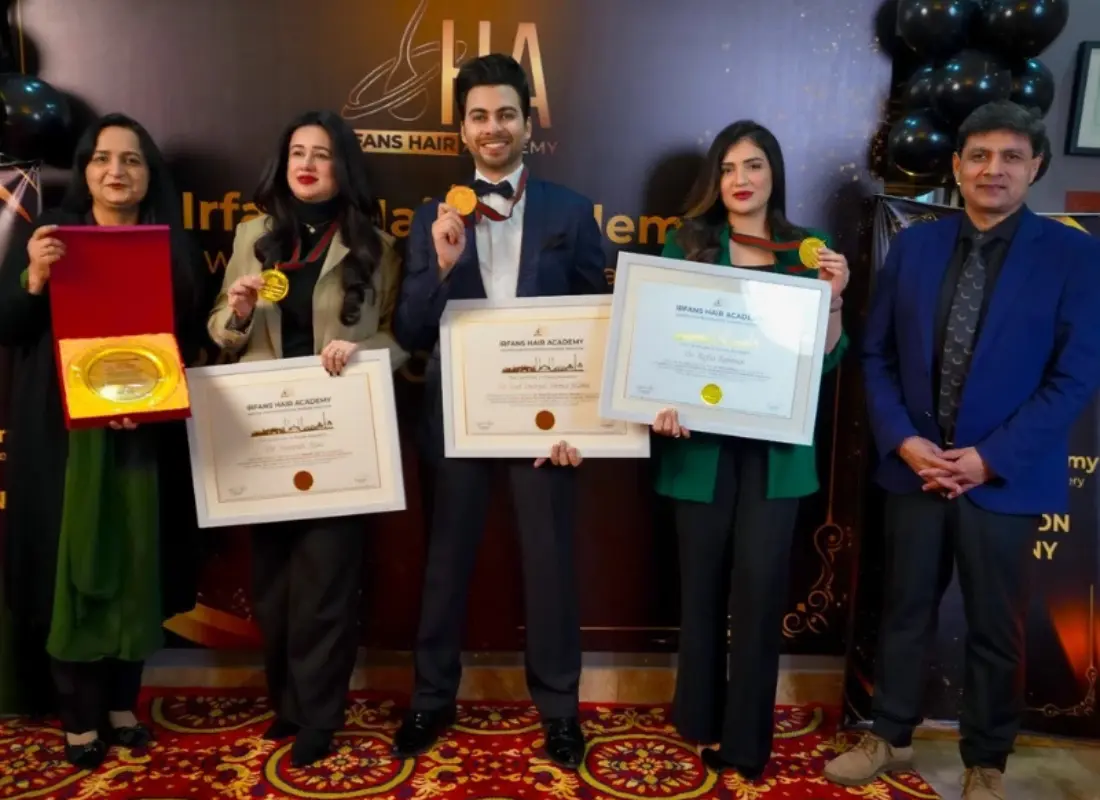
On completing the programme, doctors receive an internationally recognised certificate from Irfan’s Hair Academy documenting supervised, live-patient training across FUE, DHI, Sapphire FUE and FUT/LSE. Its weight comes from the credentials behind it: training led by the President of the ABHRS with 25+ years of surgical practice.
What IHA certification covers
The certificate records the techniques trained, the hands-on surgical component and the duration of supervised practice the details credentialing bodies and employers actually ask about, not just attendance.
Trainer credentials: ABHRS President with 25+ years’ experience
Dr Rana Irfan is the immediate past President of the American Board of Hair Restoration Surgery (ABHRS) and is regularly invited to teach internationally. Dr Uzma Irfan, an ABHRS-certified hair restoration surgeon, co-leads the academy’s training. Full details are in Dr Rana Irfan’s credentials and ABHRS presidency.
Where IHA-trained doctors practise today
Graduates currently practise in the UK, UAE, Saudi Arabia, USA, Australia, India and Thailand useful evidence, when you assess any academy, that its certificate travels.
Training in Pakistan vs Turkey, the UK and India: Cost, Case Volume and Value
Pakistan offers the most favourable combination of cost and live-case volume for hair transplant training. European one-to-one courses are priced around €3,000 per day, while a full month of supervised live-patient training in Islamabad typically costs less than a single week abroad with far more cases per trainee.
For doctors from the UAE, Saudi Arabia and South Asia in particular, Islamabad combines a short flight with a calendar-month programme. We cover the local training environment in more depth in our post on hair transplant training in Islamabad.
Course Duration, Fees and Upcoming Batch Dates
Monthly batches in Islamabad
IHA runs a new batch on the 1st of every month at its academy in F-8/4, Islamabad. Current scheduling shows seats for the June, July, August and September 2026 batches, each capped at 7–10 doctors.
What’s included
Tuition covers theory sessions, all hands-on surgical training on live patients, instruments and consumables used during training, course materials, and certification. Fee details and inclusions are provided in the brochure and confirmed at enrolment.
Booking timeline for international doctors
International doctors should book roughly six weeks ahead of their preferred batch to allow time for visa processing, flights and accommodation. Pakistani doctors can usually join the next available batch, subject to seats.
Reserve Your Seat in the Next Batch
Ready to add hair restoration surgery to your practice? Batches at Irfan’s Hair Academy are limited to 7–10 doctors for genuine one-to-one surgical supervision, and a new batch starts each month, so seats in any given month are few by design, not by marketing.
Frequently Asked Questions
Can an MBBS doctor without dermatology training enrol?
Yes. The course is designed for qualified medical doctors, including MBBS graduates, dermatologists and plastic surgeons. Training begins with foundational scalp anatomy and patient assessment before progressing to supervised surgery, so prior aesthetic or surgical specialisation is not a prerequisite for enrolment.
How many live patients will I work on?
Trainees participate hands-on in surgical cases throughout the month-long programme, rotating through extraction, graft handling and implantation on live patients under direct supervision. Exact case numbers vary with the monthly surgical list, but daily operating exposure is the core of the course.
Is the certificate recognised in the UAE, KSA and UK?
IHA’s certificate documents supervised live-patient training under an ABHRS President, and graduates currently practise in the UK, UAE, Saudi Arabia, USA and Australia. Licensing requirements differ by country, so confirm your local regulator’s specific credentialing rules before relying on any single certificate.
What does the course cost, and are instalments available?
Fees depend on the programme selected and are detailed in the course brochure, alongside what is included. Contact the academy on +92 333 5103254 for the current fee and any available payment arrangements; total cost remains well below comparable per-day training in Europe.
How soon can I perform transplants independently after training?
Most graduates begin supervised or low-complexity independent cases soon after completing the month, building volume gradually. Competence depends on your hands-on hours during training and your early case selection which is why the course emphasises conservative first cases and offers post-course guidance.